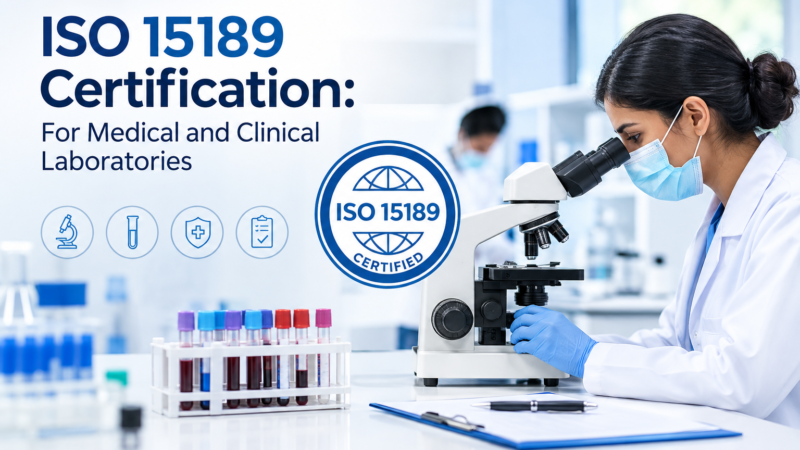
Choosing the right accreditation body in India is an important decision for testing laboratories, calibration laboratories, medical laboratories, and medical device testing facilities. Accreditation demonstrates that a laboratory has established procedures, competent personnel, suitable equipment, and a quality management system designed to produce reliable results.
As industries become more dependent on accurate testing and measurement, laboratory accreditation plays a significant role in supporting product quality, patient safety, regulatory compliance, and international trade. Understanding the applicable standards, recognition of accreditation bodies, and the accreditation process helps laboratories make informed decisions about their quality objectives.
What Is an Accreditation Body in India?
An accreditation body is an organization that assesses the competence of conformity assessment bodies, including testing, calibration, and medical laboratories, against applicable international standards.
A recognized accreditation body in India evaluates whether a laboratory can perform specific tests or calibrations competently and produce technically valid results within its approved scope.
The assessment generally covers several important areas:
- Technical competence and qualifications of laboratory personnel
- Testing and calibration methods
- Equipment maintenance and calibration
- Sample handling and traceability
- Quality management documentation
- Measurement uncertainty, where applicable
- Reporting of results and quality assurance procedures
Accreditation is not simply a certificate displayed on a laboratory’s premises. It represents an assessment of technical competence for specific activities included in the laboratory’s approved scope.
Key Standards Used for Laboratory Accreditation
Different laboratories require different accreditation standards depending on their activities and the services they provide.
1. ISO/IEC 17025 for Testing and Calibration Laboratories
The iso 17025 standard, formally known as iso/iec 17025, specifies general requirements for the competence, impartiality, and consistent operation of testing and calibration laboratories.
Laboratories working in food testing, environmental analysis, chemical testing, engineering, pharmaceuticals, and industrial calibration may use this standard as the basis for demonstrating technical competence.
The ISO/IEC 17025 certification process is commonly referred to as ISO/IEC 17025 accreditation when an accreditation body formally evaluates and accredits a laboratory. The process examines both management system requirements and technical capabilities.
Key requirements include method validation, equipment control, personnel competence, measurement traceability, and the reliability of reported results.
2. ISO 15189 for Medical Laboratories
Medical laboratories require specific quality and competence requirements because their results can directly influence clinical decisions and patient care.
ISO 15189:2022 establishes requirements for quality and competence in medical laboratories. Medical lab accreditation under this standard helps laboratories demonstrate that their examination processes and management systems meet applicable requirements.
It is relevant to diagnostic laboratories, pathology laboratories, clinical laboratories, and other medical testing facilities performing activities covered by the standard.
3. Medical Device Testing Lab Accreditation
Medical device manufacturers depend on reliable testing to evaluate product safety, performance, and compliance with applicable technical requirements.
Medical device testing lab accreditation may be based on ISO/IEC 17025, depending on the laboratory’s testing activities and applicable regulatory requirements.
The assessment may cover electrical safety, mechanical performance, material properties, chemical analysis, and other tests within the laboratory’s proposed scope. The applicable requirements depend on the device category, test methods, and relevant regulations.
Why Recognition of an Accreditation Body Matters
Selecting an accreditation body requires more than comparing application fees or assessment timelines. Laboratories should consider the organization’s competence, impartiality, accreditation framework, and international recognition.
International recognition can be particularly important for laboratories whose customers operate across different countries.
For example, the International Laboratory Accreditation Cooperation (ILAC) Mutual Recognition Arrangement (MRA) supports international acceptance of results from laboratories accredited by eligible signatory accreditation bodies, within the relevant scope.
The Asia Pacific Accreditation Cooperation (APAC) also operates a multilateral recognition arrangement for participating accreditation bodies.
Before applying, laboratories should verify the accreditation body’s current signatory status, applicable scope, and relevant recognition arrangements through official sources. Recognition should not be assumed to cover every laboratory activity or regulatory requirement.
Understanding the Laboratory Accreditation Process
The laboratory accreditation process involves several stages, from selecting the relevant standard to maintaining accreditation after approval.
Step 1: Identify the Applicable Standard
Determine whether the laboratory requires ISO/IEC 17025 accreditation, ISO 15189 accreditation, or another applicable framework. The decision depends on the type of laboratory, its activities, and customer or regulatory expectations.
Step 2: Define the Scope of Accreditation
Prepare a clear list of tests, calibrations, examination methods, parameters, and relevant facilities for which accreditation is required. The proposed scope should reflect the laboratory’s actual technical capabilities.
Step 3: Prepare Documentation and Resources
Establish the necessary quality procedures, technical records, equipment controls, personnel competency records, and method-related documentation. Laboratories should also ensure that appropriate facilities and resources are available.
Step 4: Submit the Application
Submit the application and supporting documents to the selected accreditation body according to its published requirements. The accreditation body reviews the application and determines the next steps.
Step 5: Undergo Assessment
Qualified assessors evaluate the laboratory’s management system and technical competence. The assessment may include document review, staff interviews, observation of testing activities, equipment checks, and examination of technical records.
Step 6: Address Nonconformities
If nonconformities are identified, the laboratory must investigate their causes, implement appropriate corrective actions, and provide the required evidence within the specified timeframe.
Step 7: Accreditation Decision and Maintenance
After reviewing the assessment findings and corrective-action evidence, the accreditation body makes an accreditation decision. Following approval, the laboratory must continue meeting applicable requirements through ongoing monitoring, reassessment, and maintenance of technical competence.
How to Choose Among Laboratory Accreditation Agencies
When comparing laboratory accreditation agencies, laboratories should examine several factors before making a decision.
- Applicable standards: Confirm that the body offers accreditation for the required laboratory category.
- International recognition: Check its current ILAC MRA or APAC MRA status and relevant scope, where applicable.
- Technical competence: Review the body’s assessment framework and relevant technical expertise.
- Transparency: Understand application requirements, fees, assessment stages, and decision procedures.
- Scope suitability: Ensure that the proposed accreditation covers the laboratory’s intended activities.
For organizations considering accreditation bodies for medical laboratories, it is particularly important to confirm the applicable ISO 15189 requirements and any additional national regulatory obligations. The requirements for clinical laboratory accreditation in India may vary according to the services offered and the regulatory framework involved.
Also read: Medical Device Testing Lab Accreditation: ISO/IEC 17025 Guide
Accreditation Support Through FDASIndia
The Federation for Development of Accreditation Services (FDAS) is an India-based, non-profit society established in 2019. FDAS operates its accreditation management system in accordance with ISO/IEC 17011:2017 and has stated that it became an APAC MRA signatory on 16 June 2023 and an ILAC MRA signatory on 28 August 2023 for testing and calibration laboratories.
Laboratories considering FDAS accreditation should verify the current applicable scope and recognition status against their specific requirements.
Whether a facility performs industrial testing, calibration, diagnostic examinations, or medical device testing, understanding the relevant accreditation standard is an essential first step toward demonstrating competence and reliability.
Contact FDASIndia
For information regarding applicable accreditation requirements and the accreditation services, contact FDASIndia.
Federation for Development of Accreditation Services (FDAS)
- Website: fdasindia.org
- Email: info@fdasindia.org
- Phone: +91 8448278215
- Address: 118–119, First Floor, Sushant Tower, Sector 56, Gurugram, Haryana 122011, India